No drop zone at all
Houses, pools, fences, gardens and the neighbor's roof on every side — the classic older Greenville lot. If there is nowhere for wood to fall, the wood has to go up and over instead, and that is exactly what the crane does.
Some trees cannot be climbed and cannot be dropped. The 80-foot willow oak behind a tight Greenville lot, its canopy spread over two roofs and a pool. The dead water oak whose trunk is too rotten to trust a climber's weight. The storm-split pine hung up over the house. For those trees there is one right tool: a crane, which turns a dangerous dismantling into a series of controlled lifts.
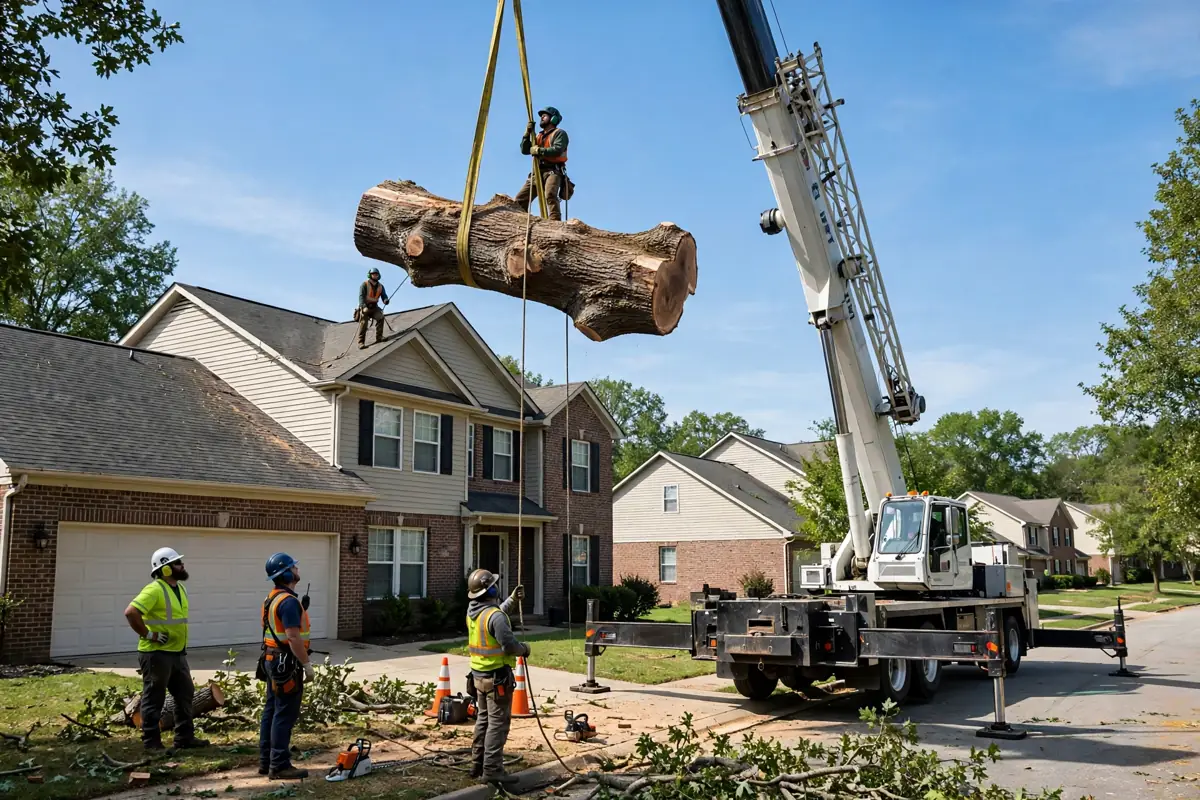
Greenville Tree Service runs crane-assisted removals across the Upstate with experienced operators and rigging crews. Each piece is cut, secured and flown out over the roof to the street — nothing falls, nothing swings free, and a tree that would take two days of risky climbing is often gone by lunch, with the yard underneath untouched.
Houses, pools, fences, gardens and the neighbor's roof on every side — the classic older Greenville lot. If there is nowhere for wood to fall, the wood has to go up and over instead, and that is exactly what the crane does.
Climbers trust the tree with their lives. When the trunk is hollow, cracked or punky — common in Greenville's aging water oaks — putting a person in it is not brave, it is reckless. The crane holds the pieces; nobody rides the tree.
Big canopy oaks carry limbs that weigh as much as a car. Rigging those by rope alone over a roof is slow and loads the remaining tree dangerously. Crane picks take each piece at its true weight, straight up.
A tree leaning on another tree, or a top hung in a canopy under tension, is unpredictable wood. The crane secures the piece before it is cut free, so the release is controlled instead of violent.
Landscaped yards, new sod, paver patios — where dragging brush and dropping rounds would wreck the property, the crane flies everything out over the top. The only footprint is where the crane sets up on the street or drive.
We measure the tree, the reach, the setup surface and the flight path over the house, then match the crane size to the heaviest pick. You get the plan and a flat written quote — crane jobs are never billed as open-ended rentals.
The crane sets on mats or cribbing to protect pavement, outriggers are leveled, the street or drive is coned, and the landing zone for pieces is established where the chipper and trucks wait.
A climber or lift positions the rigging, the crane takes the strain, the cut is made, and the piece flies clear to the landing zone. Radio communication between cutter and operator runs the whole sequence — no surprises, no free swings.
Where a climber would spend hours chunking a trunk down, the crane removes it in a few large picks — faster, safer, and with far less total time spent working over your roof.
The stump is ground if you chose it, the landing zone is cleared, lawns and drives are blown clean, and we walk the site with you. Most crane removals leave less trace than a conventional one.
Crane work is priced as a complete job, not a rental clock: published ranges for crane-assisted removal typically run $2,000–$5,000 for a large residential tree, driven by the crane size required, the number of picks and how much of the tree hangs over structures. Against intuition, that often compares well with the alternative — two days of high-risk climbing on the same tree bills similarly and carries far more risk over your roof.
What you are buying is certainty: the heaviest piece on the job is engineered, not estimated. Our quotes itemize the crane, the crew and the cleanup as one flat number, and if a survey shows the tree can come down conventionally for less, we will tell you — the crane is a tool we recommend when it earns its place, not a default upsell.
Crane removals are choreography: the operator, the cutter and the ground crew working one plan on radios. Our crews run these jobs regularly across the Upstate — big oaks in Greenville's older neighborhoods, storm trees in Mauldin and Simpsonville, tight-lot removals in Greer — and the experience shows in the calm of the job site. Neighbors watch these removals like a show because, done right, they look effortless.
We are also strict about the unglamorous parts: verified crane capacity for the heaviest pick, protected pavement, permits or street coordination where a setup needs it, and insurance that actually covers crane operations. Ask any company quoting you a crane job for exactly those things — then ask us.
Ready when you are: call (864) 555-0147 for crane-assisted tree removal anywhere in Greenville, Mauldin, Simpsonville, Greer, Taylors and the rest of the Greenville metro.
Typically $2,000–$5,000 for a large residential tree, depending on crane size, number of picks and how much of the tree is over structures. It is quoted as one flat written price for the whole job — crane, crew and cleanup — never as an open hourly rental.
For the trees it is used on, yes, decisively. Nobody's weight is in a dead or rotten trunk, no piece is ever dropped or swung on a rope over your roof, and every load is lifted at its measured weight. It removes the two biggest risks in tree work at once.
The crane sets up on mats and cribbing that spread the load, and we survey the setup surface with you beforehand. Pieces land in the street or a designated zone — your lawn never becomes the drop zone, which is the entire point of the method.
Most single-tree crane removals are completed in half a day to a day — often faster than a conventional removal of the same tree, because the trunk leaves in a few large picks instead of dozens of small ones.
Very likely. A dead, leaning tree over a structure is the textbook crane case: it cannot be climbed safely and it cannot be felled. Send us photos with your request and we will survey it as a priority — dead leaners over roofs should not wait.
A storm-damaged tree under tension can roll, split or drop a limb without warning — and a chainsaw in the wrong hands makes it worse. We answer 24/7 across Greenville and the Upstate — call now and get it made safe, today.