Greenville's tree canopy is the reason people love living here — and the reason tree removal is serious work. The Upstate's mature willow oaks and water oaks grow 60 to 80 feet tall over roofs, driveways and power lines, and when one dies, leans or splits in a storm, it cannot simply be felled. It has to come down the way our crews take it down: in rigged pieces, lowered on ropes, with nothing left to chance over your house.
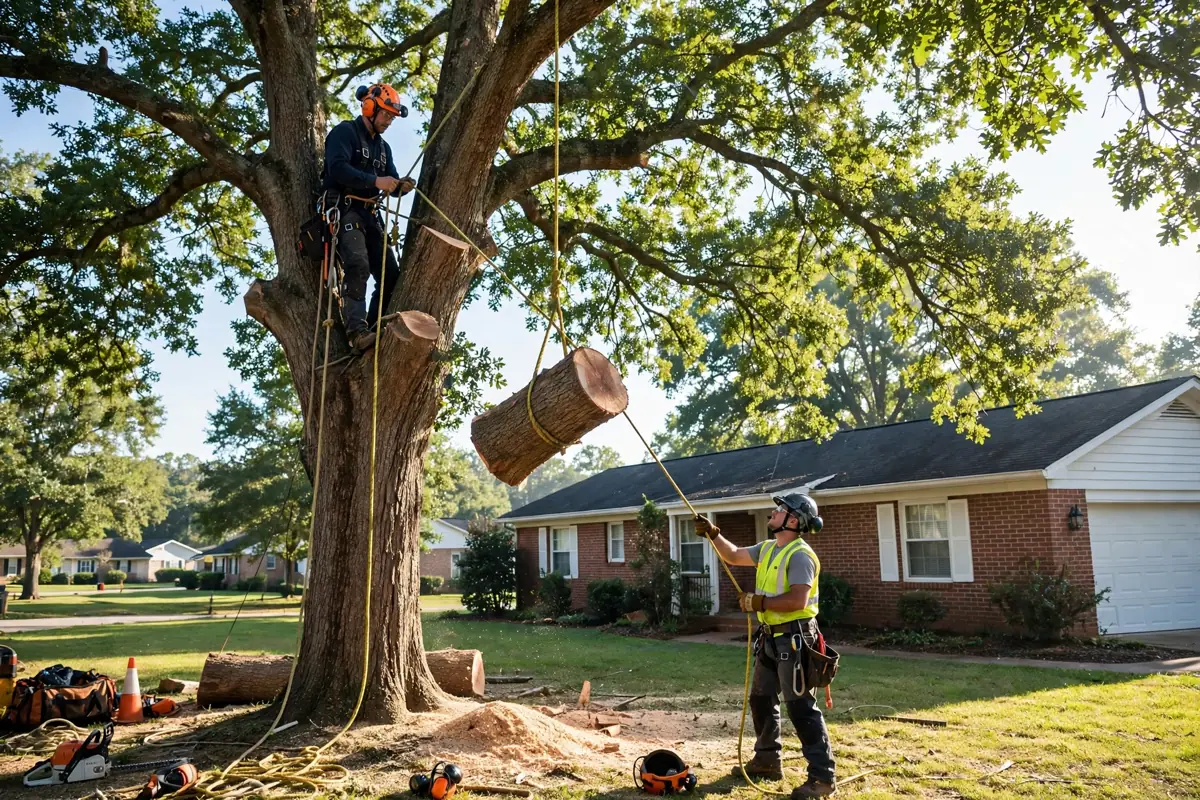
Arborist roping down a cut section of a large oak during a tree removal in a Greenville SC yard.
Greenville Tree Service removes trees of every size across the Greenville metro — dead and dying trees, storm-damaged trees, trees outgrowing their space and trees standing where a pool, addition or driveway needs to go. Every removal is quoted flat in writing before work begins, the stump can be ground the same visit, and the yard is left raked clean, not covered in your old tree.
Signs a Tree Needs to Come Down — Not a Wait-and-See
Dead wood through the crown
A tree that leafs out late, thinly, or only on one side is telling you its root system or trunk is failing. Whole dead sections in the upper canopy — common in Greenville's aging water oaks — mean decay has a head start, and dead tops drop limbs without warning.
A lean that is new or getting worse
Many healthy trees grow with a natural lean. A lean that appeared after a storm, or one paired with cracked soil and lifting roots on the opposite side, means the root plate is letting go. That tree is on a countdown, and the next saturated-soil storm is when it goes.
Cracks, cavities and fungal growth
Vertical cracks, seams where the trunk sounds hollow, and mushroom-like conks at the base all point to internal rot. An oak can look full and green while its center is punk — which is exactly why these trees fail on calm days as well as stormy ones.
Roots damaging the house or driveway
Willow oak roots heave sidewalks, crack driveways and press on foundations all over Greenville's older neighborhoods. When the damage is structural and root pruning would kill or destabilize the tree, removal is the honest answer.
Storm damage and split trunks
A split crotch, a hanging top, or a trunk torn open by a fallen neighbor tree leaves the remainder under dangerous tension. Storm-damaged trees are the most unpredictable wood we handle — they are assessed before anyone climbs or cuts.
Too close, too big, wrong tree
A loblolly pine planted as a sapling screen is a 90-foot sail twenty years later. Trees that have outgrown their space — crowding the roof, the lines or each other — come out cheaper and safer now than after the next ice storm makes the decision.
How We Remove a Tree — Our 5-Step Process
1
Assessment and a written flat quote
We look at the tree's health, lean, targets underneath and access, then give you one flat price in writing — removal, haul-away and stump options itemized. The price you approve is the price on the invoice.
2
Site protection and drop-zone setup
Plywood goes down over lawns and driveways where equipment crosses, fragile plantings are flagged, and the rigging plan is set: what gets lowered, what gets roped, and where every piece lands.
3
Canopy taken down in pieces
A climber (or the bucket, or the crane where the tree demands it) works the tree down section by section. Limbs are rigged and lowered, not dropped, and the trunk comes down in rounds sized to the space — not to our convenience.
4
Trunk, brush and wood cleared
Brush is chipped on site, logs are cut and hauled or stacked as firewood if you want them, and the stump is ground if you chose it. Nothing is left leaning on your fence or sitting in your driveway.
5
Raking, cleanup and walk-through
We rake the work area, blow off drives and walks, and walk the job with you before we leave. A removal is finished when the only sign we were there is the sunlight where the tree used to be.
What Does Tree Removal Cost in Greenville, SC?
Published Greenville-area ranges put most residential removals between $372 and $1,394, with a national average around $750 per tree. Small trees under about 30 feet in open ground start near $200–$400; a mid-size oak over a lawn typically lands in the $600–$1,200 band; and the big jobs — an 80-foot willow oak over a roof, tight access, crane required — run $1,500–$2,000 and up, with emergency and crane work reaching $2,000–$5,000 on the hardest trees.
What moves the price is size, condition and what is underneath: a dead tree that cannot be climbed safely, a trunk over the house instead of the yard, and stump grinding added or skipped. Beware the two extremes of quote — the suspiciously cheap bid usually means no insurance, and in tree work an uninsured crew's accident becomes the homeowner's problem. You always get our number flat, in writing, before anyone starts a saw.
Why Greenville Homeowners Choose Greenville Tree
Tree removal is the one home service where the cheapest bid can cost you a roof. Our crews are insured, our climbers work to ANSI safety standards, and our rigging plans assume the piece being lowered weighs more than it looks — because it always does. We would rather spend twenty minutes on rope work than one second explaining a limb through a skylight.
We also tell you when a tree does NOT need to come down. A sound oak with a dead limb needs pruning, not removal, and we say so — Greenville's canopy is worth keeping where it is safe to keep. When removal is right, we do it once, cleanly, and the quote never changes mid-job.
How much does tree removal cost in Greenville, SC?
Most Greenville removals fall between $372 and $1,394 (the published local range), with a national average near $750. Small open-yard trees start around $200–$400, large oaks over structures run $1,500–$2,000+, and crane or emergency work can reach $2,000–$5,000. Your quote is flat and in writing after we see the tree.
Do I need a permit to remove a tree in Greenville?
For most single-family residential lots in Greenville County, no city permit is required to remove a tree on your own property — but HOA rules, historic-district overlays and city-of-Greenville street-tree rules can apply. We flag it during the quote if your address falls under one, and the final check is always with your HOA or the city.
Will you grind the stump too?
Yes — stump grinding can be added to any removal and is usually done the same visit, ground 6–8 inches below grade so you can seed or sod over it. It is priced separately and itemized on your quote.
Can a tree close to my house be removed safely?
Yes — that is the normal case in Greenville, not the exception. Trees over structures come down in small rigged pieces lowered on ropes, and the tightest ones come out by crane. Nothing free-falls toward your roof, ever.
What happens to the wood and brush?
Brush is chipped and hauled away, and logs are hauled unless you want them kept — many customers keep oak cut to firewood length. Either way it is decided on the quote, not left as a surprise pile.
Need Tree Removal in Greenville?
A storm-damaged tree under tension can roll, split or drop a limb without warning — and a chainsaw in the wrong hands makes it worse. We answer 24/7 across Greenville and the Upstate — call now and get it made safe, today.