Tree Health, Disease & Pest Care in Greenville, SC
Not every sick tree is a dying tree — but every dying tree was once a sick one whose early signs got missed. The Upstate's heat and humidity are hard on shade trees: bacterial leaf scorch works through Greenville's oaks street by street, borers find every stressed pine, and the red clay that anchors these trees also suffocates roots buried under years of added soil and mulch volcanoes.
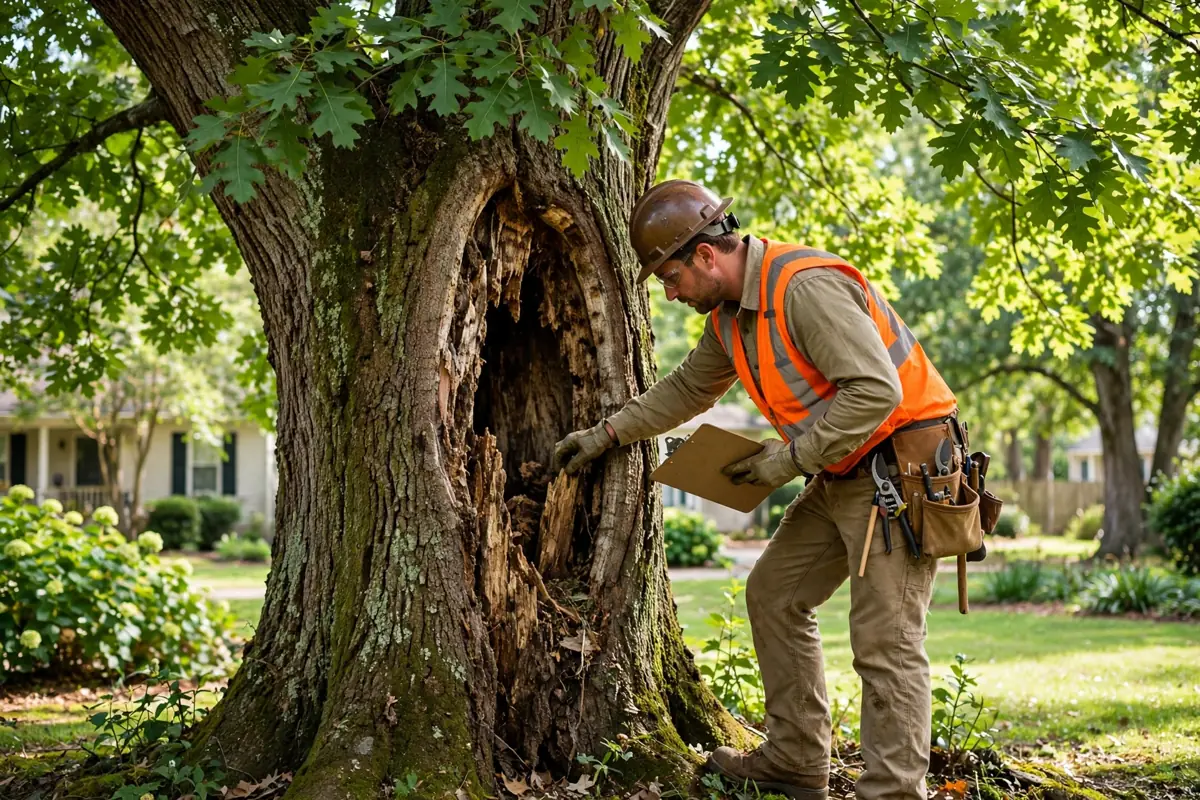
Arborist examining the bark and trunk of a mature oak during a tree health inspection in Greenville SC.
Greenville Tree Service's health care work starts with diagnosis, not a sales pitch: what is actually wrong with the tree, whether it can be treated, what treatment honestly costs, and what happens if you do nothing. Sometimes the answer is a treatment plan. Sometimes it is pruning and better soil care. And sometimes the honest answer is removal — but you will hear the reasoning either way, from someone who looked at the tree, not a quota.
Signs Your Tree Is in Trouble
Thinning crown and dieback at the tips
Branches dying from the tips inward, a canopy you can suddenly see through, leaves smaller than last year's — the classic picture of decline. In Greenville oaks this pattern points first to root stress, scorch or vascular disease, all of which are diagnosable.
Scorched, spotted or early-dropping leaves
Leaf edges browning in mid-summer (bacterial leaf scorch), black spots and shot-holes (fungal leaf diseases), or a tree bare by September while its neighbors hold leaves into November — foliage is the tree's dashboard, and it is reporting something.
Borer holes, sawdust and oozing patches
D-shaped or round exit holes, fine sawdust at the base, pitch tubes on pines and dark oozing wounds on oaks are insect and infection evidence. Borers rarely kill a healthy tree — they finish stressed ones — so the treatment addresses both the pest and the stress.
Mushrooms and conks at the base
Fungal fruiting bodies on the trunk or roots mean decay fungi are established inside the wood. This is a safety finding as much as a health one: internal rot is what makes apparently green trees fall over, and it changes the conversation to risk.
Bark falling off and trunk wounds
Sloughing bark, sunken cankers and cracks that weep are the trunk telling you its cambium is dying in patches. On young trees this is often mower and string-trimmer damage — preventable, and worth a frank look at what is happening at the base.
How Tree Health Care Works — Our 5-Step Process
1
On-site diagnosis
We examine the whole tree — crown, trunk, root flare, soil, site history — and the pattern across your other trees. Many Upstate problems are site problems (grade changes, girdling roots, drought stress) wearing a disease costume.
2
An honest prognosis in plain language
You hear what it is, how sure we are, whether treatment works on it, and the tree's realistic outlook with and without intervention. If the tree is a removal, we say so once, clearly, and explain why.
3
A written treatment plan and price
Where treatment makes sense — targeted insect or disease treatment, deep-root fertilization for depleted soils, root-collar excavation, corrective pruning — it is itemized and priced flat before anything is scheduled.
4
Treatment by licensed applicators
Any pesticide work is performed by South Carolina-licensed applicators, at the right season for the target — borer prevention is a spring job, for instance, and we will not sell it to you in the wrong month.
5
Follow-up and monitoring
Treated trees are re-checked on the plan's schedule and you get a plain report: improving, holding, or declining. Chronic conditions like bacterial leaf scorch are managed, not cured, and we track them honestly year to year.
What Does Tree Health Care Cost in Greenville, SC?
A diagnostic visit bundled with other work is often free; standalone health assessments and treatments are priced by the tree and the treatment. Published ranges put typical single-tree treatments — deep-root fertilization, targeted pest or disease applications — in the $150–$600 band per tree per application, with multi-tree properties and seasonal programs priced better. Root-collar excavation and corrective pruning are quoted per tree after diagnosis.
The economics are worth one sentence: a mature willow oak adds thousands of dollars of shade, cooling and property value to a Greenville home, and replacing it is a 40-year wait. Spending a few hundred dollars to keep a sound tree sound is the best money in this entire industry — and spending it on a tree that cannot be saved is the worst, which is why our diagnosis comes before our invoice, always.
Why Greenville Homeowners Choose Greenville Tree
Tree health care is where this trade's honesty is tested, because a worried homeowner will buy almost anything in a bottle. Our position is simple: we diagnose first, we treat what is treatable, we manage what is chronic, and we never sell a treatment calendar for a tree whose real problem is a buried root flare or a construction-damaged root system.
We also work at neighborhood scale when it matters. Bacterial leaf scorch and oak decline move through Greenville's streets tree by tree, and treating your oak while ignoring the pattern on your street is half a plan. We will tell you what we are seeing on your block — it affects what your tree's realistic future looks like.
Sometimes — it depends on the cause and how far it has gone. Trees declining from drought stress, soil problems or treatable pests often recover well. Trees with advanced internal decay or severe bacterial leaf scorch can be managed and slowed but not cured. Our diagnosis gives you the honest category for your tree before you spend anything.
What is killing oak trees in Greenville, SC?
The big three we diagnose are bacterial leaf scorch (progressive late-summer leaf browning, very common in local willow and water oaks), hypoxylon canker on stressed oaks, and root problems from buried root flares and construction damage. Borers and scale insects usually attack trees already weakened by one of those.
Do you fertilize trees?
Yes, where the soil calls for it — deep-root fertilization is genuinely useful on the depleted, compacted soils of newer subdivisions and around construction. We do not sell blanket annual fertilization for established trees in good soil; they rarely need it and we will say so.
Are your treatments safe for kids and pets?
Treatments are applied by SC-licensed applicators, targeted to the tree (trunk or soil applications rather than broadcast spraying wherever possible), and we give you the re-entry guidance for each product used. Most of our health work — pruning, root care, soil work — involves no chemicals at all.
How much does a tree health assessment cost?
When bundled with pruning or removal work, assessment is included. A standalone diagnostic visit is quoted flat when you call, and any treatment is priced in writing after diagnosis — never sold blind over the phone.
Need Tree Health, Disease & Pest Care in Greenville?
A storm-damaged tree under tension can roll, split or drop a limb without warning — and a chainsaw in the wrong hands makes it worse. We answer 24/7 across Greenville and the Upstate — call now and get it made safe, today.